Loading...
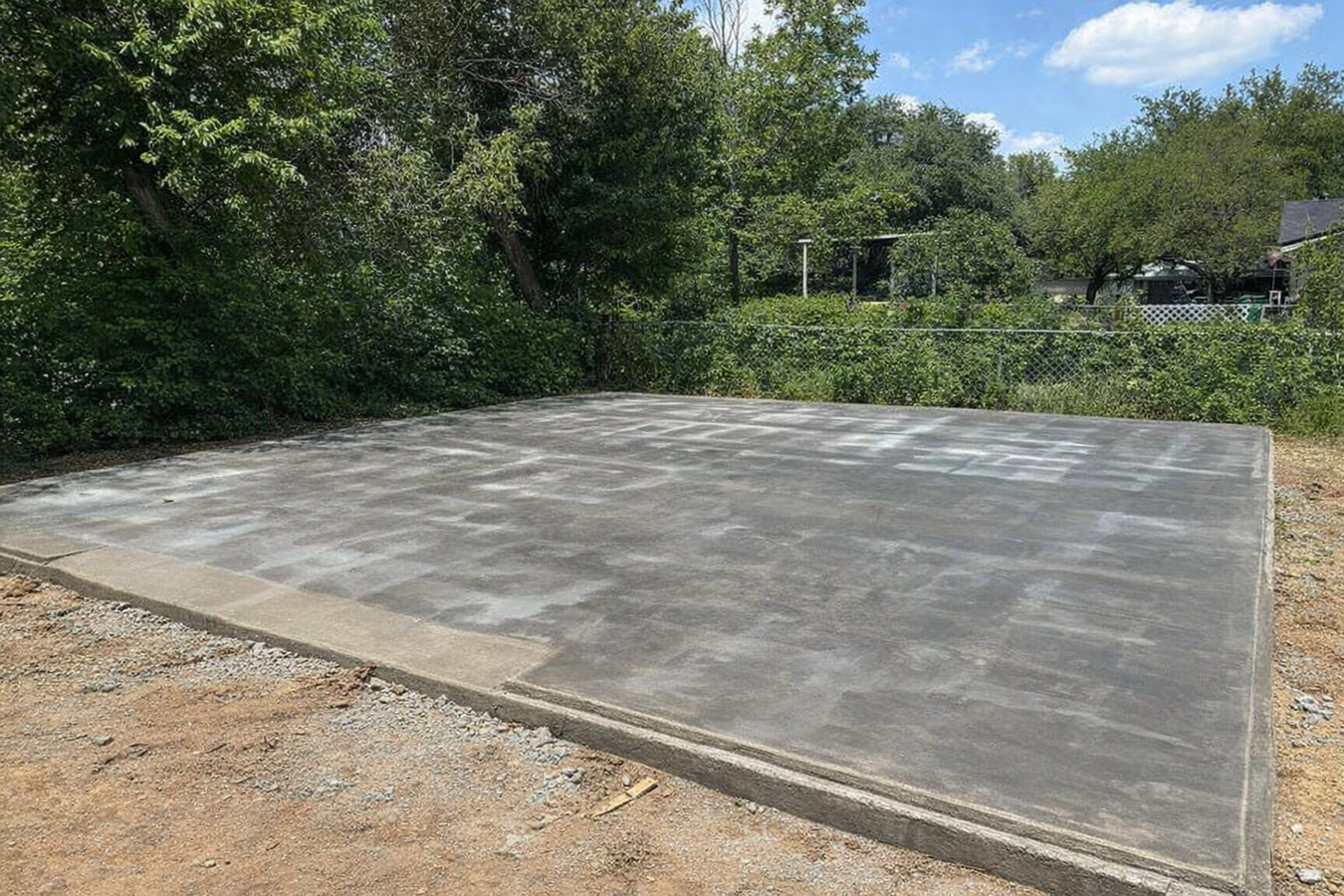
Manhattan's clay soil moves with the seasons. A slab built without accounting for that will crack. We prepare the ground right so your foundation holds up for decades.
Slab foundation building in Manhattan means pouring a single reinforced concrete pad directly on prepared ground - most residential slab projects take two to four active work days plus a week of curing time before framing can begin. The slab becomes both the floor and the structural base of your home, sitting on compacted soil, a gravel drainage layer, and a vapor barrier that keeps ground moisture out.
Manhattan homeowners building additions, garages, or new homes on vacant lots need a concrete slab contractor who understands what is under the ground here. Riley County clay soil expands and contracts through every wet spring and dry summer, so proper compaction and sub-base prep are not optional - they are what separates a slab that stays tight from one that cracks in three years. If your project also needs footings for posts, beams, or walls, our concrete footings service can be coordinated alongside the slab pour.
Once your slab is complete and passes city inspection, the next step is typically framing. If your project also involves a full foundation wall system, our foundation installation work covers the full scope from excavation to finished, waterproofed walls.
The clearest sign is simple: you have a lot or cleared area and need a structural base before any framing begins. Without a properly built slab, nothing else can go up safely. If your builder or architect has specified a slab foundation for your project, this is the first trade to schedule.
In Manhattan's clay-heavy soil, areas that hold water after a storm signal the ground has not been properly graded or compacted. Building a slab on soft, uneven ground without addressing it first leads to cracking and settling. A concrete contractor can assess whether your site needs additional preparation before pouring.
If you can see cracks you could slip a coin into, or sections that have shifted up or down relative to each other, the slab has moved significantly. In Manhattan, this kind of movement is often tied to clay soil expanding and contracting through wet and dry seasons. A new slab with proper soil prep is often the right long-term fix.
When a slab shifts, the walls above it shift too - and that shows up as doors that suddenly stick, windows that will not close fully, or visible gaps at the top corners of door frames. These are signs the foundation has moved. In Manhattan's climate, this kind of seasonal movement is worth taking seriously before it gets worse.
We build residential and light commercial slab foundations from the ground up - excavating and grading the site, compacting the sub-base, laying the gravel drainage layer, installing the vapor barrier, setting rebar or wire mesh reinforcement inside the forms, and pouring ready-mix concrete to the specified thickness. Most residential slabs run four to six inches thick, with heavier sections under load-bearing walls and posts. Every pour includes proper surface finishing so the slab is level, smooth, and ready for flooring or framing. If your project also requires point-loaded footings for columns or beams, our concrete footings work can be added to the same project scope.
We handle the City of Manhattan building permit from day one and coordinate the required city inspection before framing begins. For projects that go beyond a slab - full basement foundations, crawl space walls, or deep foundation work - our foundation installation service covers the full scope, from excavation to waterproofed and inspected walls ready for construction.
Best for homeowners building a new single-family home on a vacant or cleared lot where a slab-on-grade design has been specified.
Best for homeowners adding a detached garage, workshop, or storage building who need a durable, level concrete floor and structural base.
Best for homeowners expanding their existing home with a room addition, sunroom, or enclosed porch that needs its own structural pad.
Best for homeowners whose existing slab has shifted, cracked significantly, or was originally poured too thin for the current use of the space.
Manhattan sits at the edge of the Flint Hills, where clay-heavy soils are the norm across much of Riley County. These soils swell when wet and shrink when dry - and that movement is not subtle. A slab that was designed for stable, sandy soil will not perform the same way here. Proper sub-base compaction, a gravel layer that drains away from the slab, and reinforcement sized for the load all matter more in Manhattan than in parts of Kansas with more forgiving ground. The City of Manhattan also requires a building permit and inspection for all new foundation work, which means your contractor needs to know the local process and pull the permit before work begins. You can learn more about what the city requires at the City of Manhattan Building Permits page.
Manhattan's construction market also tends to get busy quickly in late spring once the weather turns. Homeowners near the K-State campus area and in the northwest subdivisions off Kimball Avenue regularly book slab work in late winter to get ahead of the season. We serve the full region, including Junction City to the west and Abilene to the northwest, where soil conditions are similar and the same permitting care applies. The National Ready Mixed Concrete Association publishes standards for concrete mix quality that we follow on every pour.
We will ask basic questions about your project - slab size, location, and intended use. You will hear back within one business day, and most homeowners get a site visit scheduled within a few days of first contact.
We come to your property, look at the ground conditions, measure the area, and check truck access. After the visit, you get a written, itemized quote covering labor, materials, site prep, and permit fees - not just a single number.
We apply for the City of Manhattan building permit before any work begins. Once approved, the crew grades and compacts the ground, lays the gravel base and vapor barrier, and sets the rebar or mesh inside the forms. This prep day is the most important day of the whole project.
On pour day the concrete truck arrives and the crew finishes the surface in a few hours. The slab then cures for at least a week - the city inspector visits during this period. Once the inspection passes and curing is complete, your foundation is ready for framing.
We handle the city permit from day one. Written estimate after a free site visit. No surprise charges.
(785) 236-2117We visit every job site before giving a price - because Manhattan's clay soil varies by neighborhood and lot, and the right sub-base prep cannot be determined from a phone call. That site visit is the step that prevents cracking problems years down the road.
Manhattan requires a permit and inspection for every new foundation pour. We submit the application before work begins, schedule the inspector at the right stage, and hand you the documentation when the job is done. Your home's record stays clean.
Manhattan's ground freezes 18 to 24 inches deep in a typical winter. Every slab we build sets perimeter footings below that depth so the freeze-thaw cycle cannot lift or crack your foundation. Contractors who skip this step are building for a warmer climate, not yours.
You get a written quote that breaks out labor, materials, gravel base, vapor barrier, rebar, permits, and cleanup separately. That way you can compare bids accurately and know exactly what you are paying for. No surprises after the pour. The American Concrete Institute sets the technical standards we follow on every residential slab.
Every one of these practices comes back to the same idea: a foundation you can build on confidently, without watching for early cracks or worrying about a permit problem when you sell. Manhattan homeowners have been trusting us with their concrete work since we opened, and we plan to keep earning that trust one project at a time.
Full foundation installation with excavation, poured concrete walls, waterproofing, and drainage for new home builds and major additions.
Learn morePoint-loaded and continuous concrete footings for posts, beams, columns, and perimeter walls where depth and bearing capacity matter.
Learn moreSpring contractor calendars fill fast in Manhattan - reach out now for a free site visit and written estimate so you have a confirmed start date, not a vague window.